
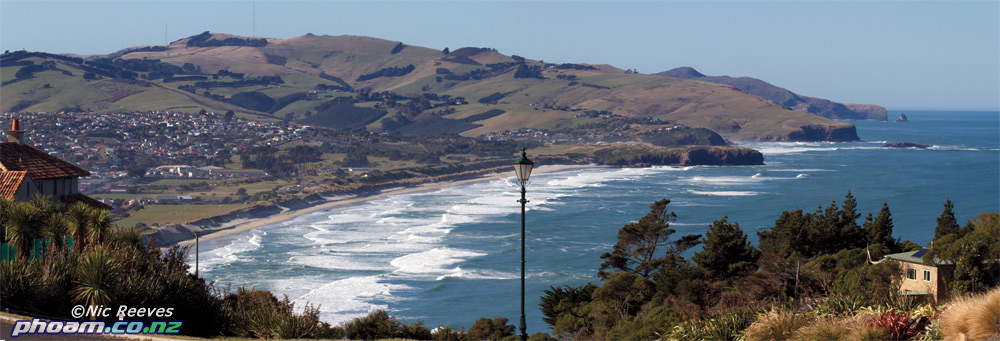
Above: Back Beach Brighton beach a few days ago, by a stormwater outfall pipe. This small stretch of beach is the only place on the south coast that holds this rich golden sand.
Below: some puppies having their first experience at the beach.


Closes: 25/11/2011
In 2008, the Council appointed a Project Team to gather data and consider management options for Ocean Beach. This followed significant erosion on the beach in June/July 2007, the DCC’s replenishment of sand on the beach and other remedial works as part of a now established ‘holding pattern’, and a comprehensive consultation process. Since then the Project Team has gathered and analysed that data and completed a risk assessment process. It has now identified proposed management options for Ocean Beach, taking into account the existing processes and risks.
A report from Tonkin & Taylor dated October 2011 entitled: ‘Ocean Beach, Coastal Issues and Options’, sets out preferred options for managing the area using an adaptive management approach. The report is available for inspection at the DCC’s Customer Services Centre and Libraries from Tuesday 25 October during their ordinary opening hours. A summary of intent and submission forms are also available. The information, plus background material on erosion at Ocean Beach, can be found at www.dunedin.govt.nz/consultation.
Submissions must be received by 5.00 pm on Friday 25 November. Hearing dates have been scheduled for Tuesday 31 January to Thursday 2 February 2012. Please state in your submission whether or not you wish to be heard.
| Closing date | 25/11/2011 |
|---|---|
| Contact person | Business Development Team Leader |
| Public feedback |
|
| Public meetings | The public meeting is to be held on Monday 7 November 2011 at 7.00 pm. The venue is the Port Otago Room, first floor, Edgar Centre, corner Portsmouth Drive and Teviot Street. All interested members of the public are cordially invited to attend. A summary of the options and submission forms will also be available at the meeting . |

This will be a meeting of the minds to discuss how to protect surfing coastlines worldwide from the effects of climate changeand the impacts of increasing populations flocking to the coast.
What Is The Value Of Waves?
Various initiatives for the preservation of the waves are conducted internationally. Therefore NGOs Surfers Against Sewage, Surfrider Foundation, Save the Waves Coalition, Salvem O Surf, with scientific support of Dr Tony Butt, organize a major international conference on the recognition of the value of the waves and their protection in the world.
While the coasts are attracting more and more people and territories seek to protect against the effects of climatic disorder, conservation of surfing waves is becoming a major issue on many coastlines.
The genesis of the waves comes from the alignment of multiple environmental factors, themselves relatively uncertain. This feature is responsible for vulnerability to any change in the environment that characterizes the waves.
This is why many surf spots have now been altered. Some even disappeared. There are several types of threats that can cause the disappearance of a wave.
Against this backdrop, the challenge for the surfing community is to highlight the fact that the presence of a wave exceeds the notion of pleasure it can bring to surfers. The objective is to characterize what are the economic, social and environmental values of a surf zone to a coastal area.
1. How Do You Define The Value of a Wave, and by Extension, of Nature?
2. What Are the Threats Facing the Waves?
3. Which Strategies Can Be Put into Place to Protect them?
These three questions will be at the centre of the conferences that take place on the two days.
To answer them, Surfers Against Sewage from the United Kingdom, Save the Waves Coalition based in Northern California, WiLDCOAST from Mexico,
Surfbreak Protection Society coming from New Zealand,National Surfing Reserves from Australia, Portugal'sSalvem O Surf (…) and of course branches of the international Surfrider network (Australia, Argentina, Europe, Japan, Morocco, United States…) will all come together.
Representatives of the political and scientific worlds, joined by engineers specializing in coastal development, will discuss the issues surrounding waves within their respective areas of expertise.
Through a series of lectures and roundtable discussions, during which various experts will attempt to answer these questions, this event is the first major opportunity to offer the public an international panorama of reflections made in this area. This event will be considered as a success if:
We manage to use this exchange as a platform to discuss our larger goals as a global community of activists dedicated to wave protection. As such, we would like to introduce the idea of a global network of wave protection.
We are able to demonstrate a shared vision and how to continue the collaboration of all stakeholders in the future.
Potentially develop a joint conference statement on wave protection to set the stage for work plan for a future wave conference. Other ideas or initiatives can emerge, for instance to have the waves and surfing recognized as a worldwide natural heritage for mankind.

The purchaser is understood to be Thai restaurant chain operator Murray Macarthy, but he did not return calls yesterday.
A decade ago, Mr Macarthy bought and demolished the nearby St Clair dairy, sandwiched between the Metropole and Hydro buildings within the Esplanade block, but the section has since lain bare.
When spoken to in March, Mr Macarthy was operating 12 Thai restaurants and had no plans to sell the vacant St Clair section.
After being bought out in March of his share of the construction of the new St Clair Beach Resort boutique hotel in the Esplanade block, Mr Chittock next put his remaining property assets in the block up for sale in June.
In early August, Mr Chittock placed his companies in voluntary administration, as part of an attempt to attract new equity investors, but nothing transpired.
However, amid reports his liabilities stood at $5 million against assets of $5 million, Mr Chittock's refinancing options began to unravel.
South Canterbury Finance's receivers were identified as the largest creditor, owed $1.5 million, and the receivers exercised their right to place his companies - White Island Investments, White Island Properties and St Clair Village Hotels - in receivership. The voluntary administrators withdrew from proceedings last week.
Mr Chittock's properties for sale have a combined value of $4.4 million and cover a total 2739sq m footprint, made up of the seven-unit Esplanade Motels and Apartments complex, Swell restaurant and three private residences. One of the houses sold for about $400,000 recently.
Mr Chittock had previously driven an Esplanade rezoning change to allow small scale commercial outlets. He was understood to have paid about $1.3 million for the Swell house, which cost a further $400,000 to redevelop into the restaurant.
Insolvency Management Ltd of Dunedin is overseeing receivership of the three companies.
When contacted yesterday, about where the proceeds of the more than $1 million Swell sale and $400,000 house would go, Iain Nellies said the money would be distributed to secured creditors, such as the mortgage holder and secured business creditors. The receivers' first report is not due to be released until next month.
Colliers International has been marketing Mr Chittock's Esplanade property assets.
Contacted yesterday, Stephen Cairns, of Colliers in Dunedin, said there were separate offers on the residential house beside Swell and also another in Bedford St, while the real estate company was "in talks with several parties" over a possible sale of the motel block.
From the early 2000s, companies of Mr Chittock's purchased or held interests in up to nine of 16 properties (five commercial and 11 residential) within the Esplanade block.
After redeveloping the 12-apartment Majestic Mansions block in Bedford St, he sold the complex in March 2009 for an undisclosed sum.
 16th October at 12 noon 85 surfers paddled out at The Spit beach Aramoana to form a circle of celebration for the Aramoana/Spit wave.


 A video is being produced, published this week sometime.


The public will be asked to have their say as the Dunedin City Council considers plans to combat erosion at Middle Beach that could lead to a "managed retreat" from the area.
Councillors at yesterday's council community development committee agreed to consult the public on a draft Ocean Beach management plan prepared by consultant Tonkin and Taylor.
The draft plan covered an area stretching 4km from St Clair to Lawyers Head and includes Middle Beach, where serious erosion occurred following severe storms in 2007.
The report recommended continuing the council's holding pattern of monitoring and sand replenishment work - put in place following the 2007 storms - in the meantime.
However, the report also canvassed 13 longer-term options and recommended a managed retreat from Middle Beach and Kettle Park, or construction of an inland buried backstop wall to protect the area, over the next 10 to 50 years.
Initial estimates showed the work could cost between $8 million and $19 million, including a clean-up of the old landfill underneath Kettle Park at risk of being further exposed by continued erosion.
Council community and recreation services manager Mick Reece said he hoped consultation could be completed by the end of this year, with recommendations that followed considered as part of next year's long-term plan hearings.
Detailed information gathered by the council's Ocean Beach project team would also be made public through the council's website to aid the consultation process, he said.
A workshop has been organised to discuss the inclusion of surf breaks into legislative planning frameworks.
Surf Breaks Workshop (side event)
When: Tuesday 31 May, 7.30pm - 9.30pm
Where: The University of Auckland, The Design Theatre, Conference Centre, Building 423, 22 Symonds Street
Seventeen regional surf breaks were recently declared as nationally significant under Policy 16 of the New Zealand Coastal Policy Statement (NZCPS) 2010.
A workshop has been organised to discuss the inclusion of surf breaks into legislative planning frameworks. Topics to be covered include:
(a) What are surf breaks?
(b) What impact might Policy 16 have on planning and resource consent decisions?
(c) How might surf breaks be provided for through marine spatial planning and planning documents?
The group of experts who appeared before the NZCPS Board of Inquiry Hearing on Policy 16 will guide a round table workshop on these topics. These experts will include Hamish Rennie (Senior Lecturer Environmental Management and Planning, Lincoln University), Robert Makgill (Director, North South Environmental Law), Matt Skellern (Planner, University of Auckland- Surfbreak Protection Society) and Dr Shaw Mead (Technical Director, ASR Ltd).
This promises to be an interesting and informative forum. Entry is free and all are welcome
Please contact James Frazerhurst at ASR Ltd for more information j.frazerhurst@asrltd.co.nz
This is where the “The University of Auckland, The Design Theatre, Conference Centre, Building 423, 22 Symonds Street” is …

 Session on Saturday, first time in about 3 weeks that I managed to get down to the beach to take photos. A few comments on my blog, and emails about the lack of content on my blog. I'm not going to apologise for being absent, I just hope that soon I can get fixed so I can get back to my life I once knew. Two top are Andy Sutherland having a good day and Jayin on his new single fin. Below are screen shots of the whole session with Andy, Jimi, Matt & Lamby


 Posts
All Comments


phoam surf blog Copyright © 2008 Black Brown Art Template by Ipiet's Blogger Template


